- "N-" - Not resistant to oils.
- "R-" - Resistant to oils.
- "P-" - oil-Proof.
- "-95" - Able to filter out 95% of dangerous substances.
- "-99" - Able to filter out 99% of dangerous substances.
- "-100" - Able to filter out 99.97% of dangerous substances.
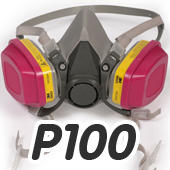
P100 Respirators
Originally posted on: September 28, 2013
⚠️ Note: This post is over 10 years old. It was originally published on September 28, 2013. It may contain outdated information on my skills, or reflect my views at that time, which could differ from my current perspectives.
For my first TotT Urban Ex article, I'm going to discuss the importance of P100 respirator masks. Going in abandoned buildings, drainage tunnels, and other places where air quality is questionable, poses several hazards.
First, there's the lead paint. Many abandoned places are old places, constructed long before lead paint was banned. As the decaying paint flakes, it leaves behind particles which settle on the floor. Though the air quality might not initially be bad upon entering, it only takes a little bit of footwork to kick up clouds of toxic lead paint dust. It's particularly unnerving when you have a flashlight in a dimly lit room, and you can see massive swaths of unknown dust floating in front of your beam.
Next, there's asbestos. Not the miracle material once thought, Asbestos turned out to be particularly nasty for the lungs, causing more than one type of cancer. When it comes to killing you, it does asbestos it can. Bah-do-chhh. Many old buildings used Asbestos as insulation for walls and pipes before fiberglass became the norm. Speaking of fiberglass, it's not much better. Fiber glass can create airborne fiber strands that can settle in the skin or the lungs. No fun.
Finally mold is yet another air quality hazard. Many kinds of mold can make you sick, but deadly black mold should be avoided at all costs. I've actually found black mold on more than one adventure. Not only did I get away quickly, I was properly equipped with a P100 respirator mask.
Respirator masks are rated with a code letter and a number, such as N95 or P100. These ratings are assigned by the NIOSH, and you should only buy a mask that is NIOSH rated and approved. The coding scheme is as follows: